Welcome, friends. If you knew Virginia B. at all, you are presumably grateful for having experienced her beautiful spirit & good will. Newcomers may connect with these through materials provided here. Even those who knew her well, however, will find surprises in the words & images she left behind, including the keenness of her observations, along with the range of her thoughts & feelings. Most of her paintings & longer poems remain off-line; as more notebooks are found & pieces typed, the more her larger creative intentions & personal musical movements clarify….
For now, the best intro to person & work may be found by sampling in any & all “rooms” listed at the top of each page (i.e., the site’s menu above). A later stage of organizing should offer recommended pathways, including sequence more faithful to her original conceptions, at least in the case of some groupings. Our uploads remain more random for now, however, with more faithfully complete groups & sequences possibly added going forward.
For now, feel free to  hop about these considerably disorganized pages to experience her gifts of perception, responsiveness, & resonance by means of simple, diverse, individually packed moments charged with breath, tone, spirit, & voice, her feeling & imagination in motion….
==========================================================
As website flunky & link in the transmission, as well as Bodlibrary host, guide, & editor,Yours Crudely confronts a creative dilemma the horns of which may be described as “stay out of the way–let the work sing for itself” & “alert the world to her & her work, helping visitors discover the range, depth & impact of her legacy,” having been not just a fellow travelers on the trails of life & art, able to point in potentially useful directions, but her close companion for more than half a century.
“And belief shall not be until the work is done,” wrote the great poet, philosopher & evolutionary sage Sri Aurobindo. For most of us, it seems the work is never done, only passed along when life is. In Virginia’s case, she went on doing her part as she lived–fully engaged in the particulars of trails & companions, exploring the geographies of inner experience feelingly, life & art one, as was her love of nature & culture, children & elders, harvest & gardening, legacy & offering.
We may note that she never called herself a poet, artist, composer or musician, practicing each simply as part of living that much more fully, both individually & together, sharing the expanded experience with friends, family & students. While she had the bodies of knowledge & natural talents to have made any of the loved arts &/or sciences her life’s work, she consciously chose teaching as her profession, a field ultimately involving all the arts, sciences, cultures, environments, & people, especially those engaged in exploring & discovering, being & becoming. In the arts, as in the wild, she remained a devoted amateur, in the original meaning, one who practiced for the love of it, not as a professional task or job.
 The values found in the arts and sciences, like those provided by society’s various infrastructures (from roads & power grids to institutions, events & community traditions), are functional parts of a common legacy. Each student might explore & discover a personal life’s path, yet also learn working & becoming together as part of a community with shared values in actual experience, balancing the dilemmas of actual life & society, scientific understanding, plus the pleasures of poetry, art, music, dance, wildlife, natural beauty, healthy land, air, water, food, friendship, awareness, wonder, inquiry, feelings, natural & cultural relationships….
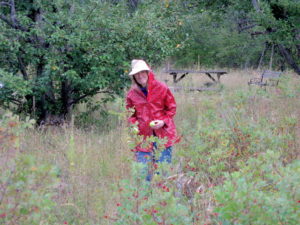
Her professional life, organically grown, was dedicated to the young of all ages, along with the environment. Individuals, community & harmony with nature weren’t primarily ideas to her, nor were the arts something for professionals, practitioners, or profit-seekers alone. Van Gogh’s works thrilled her, as did ones by Matisse, Gauguin, Monet (whose water-garden she visited more than once), the visual playfulness of Klee, Klamdripsky, Calder & Chagall & many others, local & far away, known & unknown. Each work, like each artist, was a potential gateway to discovery.
Early in her personal history, poetry, dance & music simply became part of her sense of self, along with the love of places & people, wildlife & natural science, body & mind, punctuated by a keen sense of justice & right relation. A biographer can trace each to particular early triggers in her intense direct experience, ways she found the world & became who she did–absorbing & leaving impressions in Nevada, Hawaii, the Northwest, Radcliffe, Paris, Texas, India…–with roots re-set in New Mexico’s north-central highlands from the early 1970s on, as teacher in town (Las Vegas, NM) & out, caretaker (& student) at our private 200+-acre refuge, Dragon Mountain.
Her approach to poetry was neither that of a professional writer, someone establishing herself in the field, nor of intentional teacher, someone intending to guide, inform, or model. For the most part she wrote simply to experience more fully, reflecting on life’s mysteries, wonders, sensitivities, & tribulations, the experience of exploring, expressing &/or sharing. Indeed, a significant portion of her poems were communications for particular people, written in response to specific circumstances. In many cases, it would be pointless to ask whether they’re mainly poems at all, remaining communications first & foremost, affirmations of connection. Like a tenderly crafted little clay pot or sweater knitted stitch by stitch to keep a loved one warm, the care taken in each poem’s creation embodied her sense of connection with the recipient, friends, colleagues & family members (parents, offspring, Yours Crudely, her life-partner), plus communion with the materials being shaped.
I may claim some personal role in having introduced her to the Basho legacy & encouraging her practice, along with Elizabeth Lamb (of Santa Fe), Gary Vaughn (Albuquerque), our daughter Gita, though never in a single direction, as she encouraged each of us as well, Basho’s core way of being & making resonating through her as 2nd nature, so close to her own (“let there be no barrier…”); once she got the bug, the feel of it, she gave it new life entirely on her own. Though happy to share the gift as part of an evolving linked verse adventure, she mostly celebrated glimpses of beauty & wonder in normal life & solitude, aiming her psychic camera accordingly.
It’s fair to say that her little snapshots knocked the socks off others practicing the Basho way, Elizabeth & Gary included, along with far-off afficianados. A verse of hers that I’d mailed off was named “best of the year” by the Kaji Aso Haiku Society in Boston. Another, published by the American Haiku Society’s Frogpond (when Elizabeth was its editor), received an award from the Museum of Haiku Literature in Tokyo. Though she had no objection to my doing so, she never sought publication or recognition for her work. Indeed, she resisted repeated requests from Orion Afield magazine for an article on her widely admired out-door classroom, far preferring to work with the land & students over writing about working with the land & students.
Age & a gradually progressing Parkinson’s condition changed her active focus, encouraging both professional retirement & her subsequent search for meaning through paint, music & especially poetry, experimenting with each to find some relief from the threats of confusion & physical incoherence, even as the swimmer-diver-&-dancer’s body continued giving way to an unknown, thin-boned old woman prone to falling.
Even before age had dramatically limited outside activities, her writings seemed to be undertaken entirely for her own motives—from the pleasures she found in the dance of words on paper to her efforts at sorting through more difficult feelings…word by word, movement by movement, brush stroke by stroke. After she started listening to classical music overnight, many poems became musical meditations, e.g., reacting to a long loved Sibelius symphony heard on pre-dawn radio, along with attempts to understand what was happening to her mind, brain & body in response to neurological changes….
She had always paid attention to how mind, brain & body interacted–as a hiker, bike-rider, swimmer, diver, dancer, lover…mother, again as yoga teacher, nature teacher, land caretaker, & artist; again as she experienced strange visual phenomena & imperfect muscular coordination; again with the shared tribulations of afflicted friends & death of loved ones, new territories challenging her prior verbal & visual skill-sets.
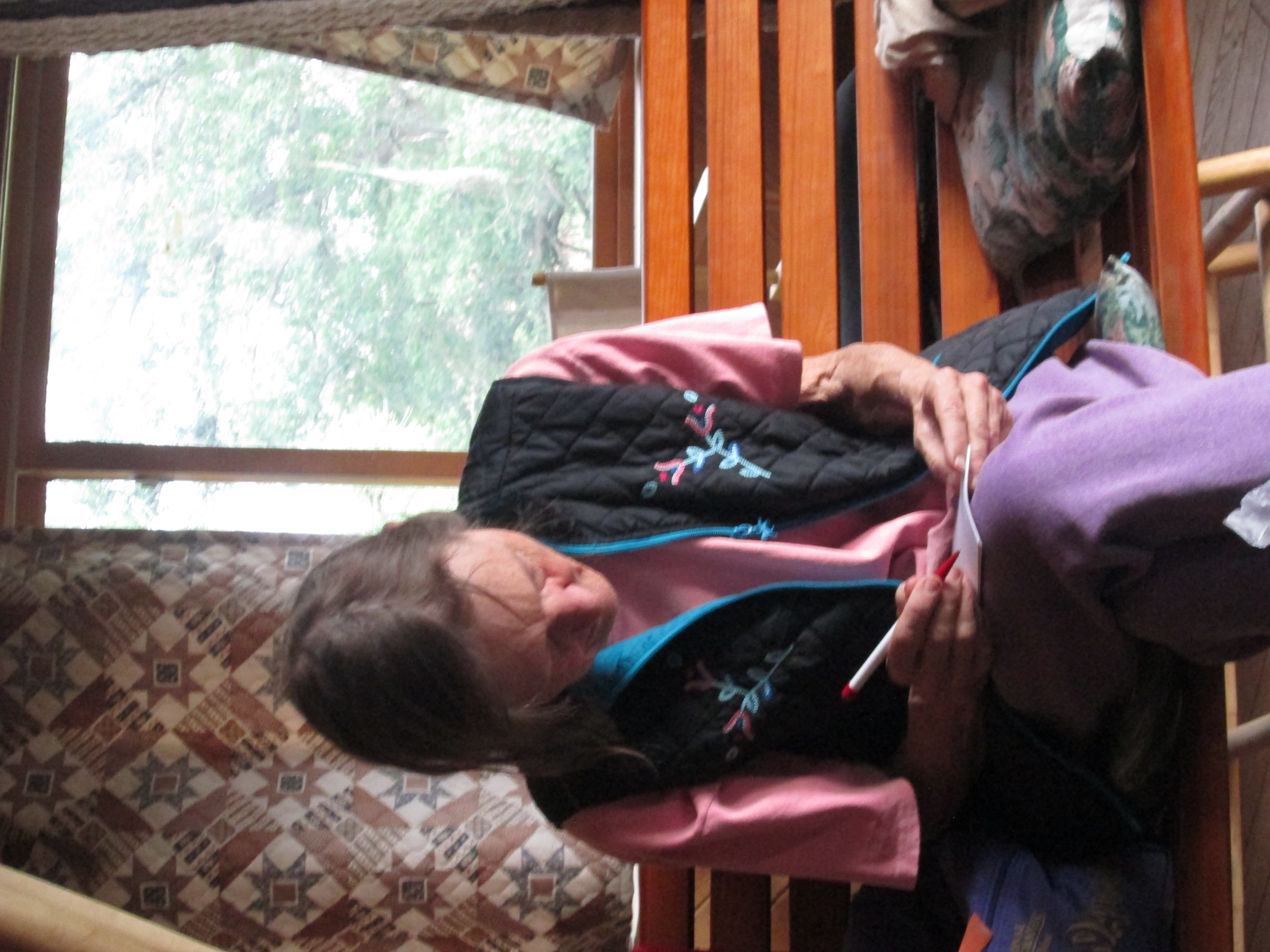
 No categories are only what they first seem, so poems written as if for (to &/or about) her own inquiring self could also turn into a direct communication to help a particular struggling friend. Another might cross the imaginary self boundary entirely, speaking to a future self, hers or other later recipient, at once the old & new original….
Still other poems became games & dances, celebrations & elegies, each defying the usual categories in its own way. The one characteristic shared across all the poetry referred to so far is that the inner poems gave rise to the outer forms, rather than vice versa. Words are grouped & laid out on the page as inner voice & feelings direct, not trying to follow a traditional idea, formula or poetic framework. Given poetic forms were not part of what she explored, with the arguable exception of those in the Basho way.
Her hokku & renga contributions emerged from the qualities of attention, more than from a conception of templates, thus fully in sync with the so-called weathergrams discussed elsewhere. Hers mostly wrote themselves, in other words, though in a formal renga session led by a contemporary visiting master, she could also fine tune inner experience to fit its place & functions in the given form.
=====================================================================================